Tuesday, April 14, 2015

Bonnie Lundgren: Psychology Major

Second-year Multnomah Psych major Bonnie Lundgren answers my questions:

Why did you choose this program?
Bonnie Lundgren
Well, I shouldn't have been, but I was surprised when I realized I needed to take psychology to get into counseling. I was also a little uncertain because my mother has been emotionally advised as a child by a guy who was a war veteran and psychology major. I attended community college for over a year, and half-way through I had this summer where I complained repeatedly to God that I was tired of trying to pick a major. I asked for him to "just tell me" for several months... finally, he did. Grief counseling. For every other suggestion, I’d had an argument or rebuttal, but not this one. A few months later, God asked me to attend Multnomah, which I was familiar with because my mom was an alumnus. I found they had a program for me, and my doubts are gone. Taking psychology at Multnomah is amazing.
What do you like best about your program?
Well, I have had great professors - Dave Jongeward, Elliott Lawless, Brandi Walters, Garrett Baldwin. The perspectives they share encourage me to view human internal workings in a way which is respectful without letting people of the hook for sin. Getting to know other psych majors is fun, too, but it's definitely the best to be able to understand that God cares about psychology - he made us how we are, and now I get to honor him in my study of it!
What misconceptions do people in other majors have about yours?
That it's really a general degree... just for fun, maybe, or so you can put something official on your transcript. I also find that I'm viewed as looking for the opportunity to psychoanalyze every person I meet, which just isn't true. That misconception has had me hesitant to share things I notice, even with those closest to me. I'm working on it, though. If I wasn't in this major, no one would question my observations about others' personalities and behaviors.
How do you hope to use your degree?
Obviously, I'm looking forward to several years of additional work to get established as a counselor. My heart for reconciliation and healthy processing of traumatic events, coupled with tires to Crisis Response International (who have been working with Syrian refugees lately) may lead me towards short-term disaster-based overseas ministry. But we'll see. It depends a lot on my husband, and who knows? We could have little ones to factor in by then.
How have you been impacted by being in this program?
I've learned to recognize certain negative behavior patterns in myself and others, cultivated empathy for the broken, remembered that even secular experts may have some truths to share with the rest of us (if we can humbly accept that and discern what is true versus misinterpretation), and I have gained greater longing to see God's redemption fully unfold on earth as it is in heaven.
What are you looking forward to about the rest of your time in this program?

As many fascinating classes as possible and, surprisingly, for another Lawless test... that man has a hidden genius for making students snicker over what should be simple multiple-choice questions. Until then, grace from my soul, spirit... and/or mind, to each of my reader's.

Wednesday, April 8, 2015

Meet Daisy Buchanan and Daisy Buchanan: The Dual Nature of Fitzgerald's Heroine

by Laura Joy Griffith

            Fitzgerald’s The Great Gatsby utilizes the literary techniques of paradox and oxymoron in many instances.  Keith Gandal calls “Gatsby’s famous doubleness…a chivalrous lover and cold-blooded killer” (qtd. in Hays 1).  Perhaps Fitzgerald’s most brilliant use of “doubleness” is in the character of Daisy Buchanan, a woman loved and desired by many.  The two key people in Fitzgerald’s novel who want Daisy for their own are her husband, Tom Buchanan, and her beau from her single days, Jay Gatsby.  Tom and Gatsby do not see the same Daisy, however.  I assert that Daisy’s two selves are linked to the two men in her life and her deliberation between the two men is really a deliberation between two selves; Daisy could have a happy, successful relationship with either Tom or Gatsby if she killed the other self and became a unified person.
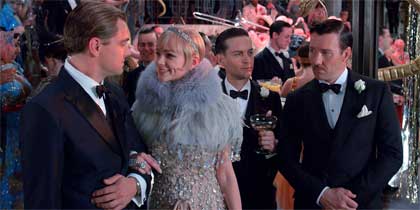
Leonardo DiCaprio, Carey Mulligan, Tobey Maguire,
and Joel Edgerton in The Great Gatsby (2013)
            Daisy’s two personalities are represented in the novel by her two hair colors.  In 1972, columnist Sheilah Graham complained that Ali McGraw could not play Daisy because McGraw had dark hair and Daisy had blond hair (Korenman 1).  Graham made the mistake, however, of only seeing one side of Daisy.  She saw only Tom’s Daisy, who is blond, and passes on her blond hair to her daughter.  When Daisy’s daughter makes a brief appearance in Chapter VII, Daisy mentions her “yellowy hair” (Fitzgerald 123) and then later asserts, “She looks like me.  She’s got my hair” (124).  In this scene, Daisy is at home with her daughter, who is of course Tom’s daughter, and so in this moment Daisy is living in the self that belongs to Tom, and she is happy.  This self is symbolized by blond hair (Korenman).
            In contrast, Gatsby’s Daisy is symbolized by dark hair.  In a description of Daisy and Gatsby’s time together before he left for the Great War and before she married Tom, Fitzgerald writes, “Now and then she moved and he changed his arm a little and once he kissed her dark shining hair” (Fitzgerald 157).  In this scene, then, when Daisy is living in this self, she has dark hair; she is Gatsby’s Daisy and she is happy (Korenman). 
            Daisy’s two personalities, while symbolized by light and dark hair, are also represented by East and West Egg.  East Egg is where old money is a cause for pride and new money is a cause for disdain.  It is where cool elegance and projected innocence are the expectations of a respectable woman.  It is where Tom and Daisy live, and it is where the blond Daisy—Tom’s Daisy—is most comfortable.  In contrast, West Eggers usually have new money.  Gatsby lives in West Egg, and his parties are filled with producers and actors, people climbing the social ladder.  Being respectable is less important in West Egg; Gatsby describes his guests as “interesting people…People who do interesting things.  Celebrated people” (Fitzgerald 96).  Only Daisy’s dark-haired self is comfortable in West Egg.  When Tom and Daisy attend one of Gatsby’s parties together, Daisy is only happy when she can get away from Tom and her blond self and live in her other self—when she can be Gatsby’s Daisy.  Nick says he knows “that except for the half hour she’d been alone with Gatsby she wasn’t having a good time” at Gatsby’s party in West Egg. 
            Daisy experiences a lot of grief from trying to live in both selves simultaneously.  When Gatsby reenters her life and demands that she leave her husband, “go to [him] and say: ‘I never loved you’” (Fitzgerald 116), Daisy is being pulled in two directions, and it is not just about two men.  It is about two selves. As we have seen, Fitzgerald clearly presents Daisy as a split person and those two Daisys—the blond Daisy and the dark Daisy—are linked to Tom and Gatsby, respectively.  As long as she only has one man in her life, she can focus on one self.  That is why she managed to survive the years between her marriage to Tom and the reentrance of Gatsby into her life without confusion.  She could put the dark-haired, West Egg, Gatsby’s Daisy in the past and live as the blond, East Egg, Tom’s Daisy.  Likewise, at Gatsby’s party, when Tom is not there and she is only with Gatsby, she is also happy because she is released from the pressures of the high-class Daisy. 
            Fitzgerald says that when Daisy decided to marry Tom instead of waiting for Gatsby to return “there was a certain struggle and a certain relief” (159); the struggle was between her two selves—the one who would wait for Gatsby and the one who would do what was expected of her and get married to this well-off gentleman—and the relief came when she chose one and followed it.  The struggle Daisy experienced is dramatically expressed in Jordan’s story of the day before Daisy’s wedding.  Daisy gets drunk and, clinging to Gatsby’s letter in which he promised to return for her, tells them she has changed her mind.  “She groped around in a waste-basket she had with her on the bed and pulled out the string of pearls [Tom had given her]. ‘Take ‘em downstairs and give ‘em back to whover they belong to,’” (81).  But when the women sober her up and force her to behave, she rejects Gatsby’s Daisy and lives as Tom’s Daisy for years—until Gatsby comes back.
            Then Daisy is faced once again with a battle between her selves.  On the day when it is exceedingly hot and they all go into town, Gatsby keeps trying to force her to make some sort of a decision.  He assumes that she chooses him—that she chooses the dark-haired Daisy.  To him, it is all about who she loves, but for Daisy, it is about who she wants to be for the rest of her life; she is not ready to make the decision just yet, so she keeps trying to change the subject and keep everyone happy (Fitzgerald 120-143).  Daisy is still sitting on that fence when tragedy strikes and the decision is made for her.  When Gatsby is killed, his Daisy dies with him.  With no Gatsby, she has no reason to be the dark-haired Daisy he loved.  She fully becomes Tom’s Daisy, then, and was finally unified for the first time since Tom had entered her life and demanded that she be someone other than the girl she was to Gatsby. 
            The direction Daisy ultimately goes explains why Sheilah Graham in 1972 claimed that Daisy is blond.  Graham is not alone.  Joan S. Korenman writes, “What is curious is that, although the dark and fair descriptions seem fairly well balanced, most readers come away from the novel convinced like Sheilah Graham that Daisy is blonde” (3).  Daisy is portrayed in all four main film adaptations of The Great Gatsby (1949, 1974, 2000, and 2013) with blond hair (IMDb).  Korenman claims that this is because the descriptions of Daisy are accompanied by imagery which is linked to blond hair: Daisy is constantly surrounded by gold and white; Gatsby says her voice sounds like money, which is connected with gold (3).  I would add that readers remember Daisy as blond because the blond Daisy is the Daisy we are introduced to at the beginning of the novel (before she reencounters Gatsby) and the Daisy we are left with at the end (after Gatsby’s death).  The Great Gatsby begins and ends with Tom’s Daisy. 
            Korenman claims that Daisy is “both cool innocent princess and sensual femme fatale, a combination that further enhances Daisy’s enigmatic charm” (5).  Daisy could be either of these selves—indeed, through most of the book, she is both of them.  Living on a knife edge, Daisy’s life was one of constant confusion, deliberation, and struggle.  Because each self was connected to a man, however, it was not simple for Daisy to choose one and live in it.  Torn between the blond, high-class, respectable wife Tom wanted her to be and the dark, sensual, interesting woman Gatsby wanted her to be, Daisy was on the verge of ripping in half until an unexpected turn of events forced her to become one and not the other.  Ultimately becoming Tom’s Daisy and rejecting Gatsby’s Daisy—rejecting West Egg along with it—Daisy Buchanan achieves the oneness she needed all along.


Works Cited
Fitzgerald, F. Scott. The Great Gatsby. New York: Collier, 1992. Print.
Hays, Peter L. "Oxymoron In The Great Gatsby." Papers On Language & Literature 47.3 (2011): 318-325. Academic Search Premier. Web. 6 Apr. 2013.
IMDb. IMDb.com, n.d. Web. 06 Apr. 2013.
Korenman, Joan S. "'Only Her Hairdresser …': Another Look At Daisy Buchanan." American Literature: A Journal Of Literary History, Criticism, And Bibliography 46.4 (1975): 574-578. MLA International Bibliography. Web. 2 Apr. 2013.


Tuesday, March 31, 2015

Coffee with Dr. Harper

Dr. Harper
multnomah.edu
by Laura Joy Griffith 

           I am sitting at a round table in the back of Roger’s CafĂ© when Dr. Brad Harper comes striding into the coffee shop, waving at students and looking around for me.  Once he finds me and is settled into the chair next to me with a latte to warm his hands, I begin to ask him questions I think will be on the hearts of Multnomah students: “What do students talk about when they come to your office?”  After a moment of thought, he looks me in the eyes and tells me that at least once a semester, a Multnomah student comes out to him, confessing that they struggle with same-sex attraction.  Usually, he says, they have not told anyone else.  This, he presumes, is because being gay is taboo in the Multnomah culture, but he has always been open about the fact that his son is gay and that they have a great relationship.  “What do you say to them?” I ask, to which he replies simply, “Mostly I listen and assure them of God’s love.”  Listening and affirmation are key, he insists.  His job is not to give them answers so much as to walk with them as they explore what it means to live a life that honors God and find friends who love them for who they really are.Some Multnomah students—undoubtedly more than we presume—struggle with being gay.  
            A more mundane struggle—but one that is just as real and troublesome—is the difficulty so many students have with the school system.  Dr. Harper says that his ideal environment for teaching theology would be at a cabin in the wilderness with fifteen students who live together and work for their own survival.  But we don’t get to learn theology in that environment.  Instead, we learn it in eight o’clock classes and from Grudem’s Systematic Theology and by citing sources in MLA format.  This system works great for some students, but for many students, it seems to be constantly undermining their ability to succeed.  Realistically, Dr. Harper says, sometimes you just have to suck it up and jump through the hoops, because the ideal environment is impractical.  Nonetheless, both students who excel in the system and those who struggle must also remember that getting good grades is not the most important thing in life.  “You have to be careful not to equate success in the system with success at education or success in life, “Dr. Harper says.  Just because we’re good at school and work well in the system doesn’t mean we’re getting a good education.  We need to ask ourselves, “What does it really mean for me to be educated?”  It probably doesn’t mean getting straight A’s. 
            At Multnomah, we question and analyze so many of the beliefs we have grown up simply accepting.  Often it feels like the very foundations of our faith are being shaken.  (Wait, premillennialism isn’t the only view??!)  But through it all, we never want to lose our faith in the good God of the Bible.  According to Dr. Harper, Multnomah provides an ideal situation to explore without getting lost.  “Honestly,” he says, “I think you’ve got one of the best places on the planet to do that, now in 2015.”  Multnomah professors are careful to provide honest representations of opposing views, rather than setting up straw-man arguments.  Students need to realize how legitimate other views are so that when they get out into the real world, they don’t question the reliability of their teachers.  Multnomah is safe, Dr. Harper says: here you won’t be judged for asking questions, and you won’t be allowed to wander off into pluralism.  Multnomah encourages students to foster their relationship with Christ, keeping love for God and others at the center.  Bottom line?  “Hang on to Christ.  It’s not about the answers to all the questions.”

Tuesday, March 17, 2015

The Best of Instagram

Multnomah students like Instagram, and so do we!  Here are some of the highlights of this year.  To see more, follow @multnomahmuse!

Matching baristas in Roger's Cafe!  @beckaleckka
Stopping to smell the roses.  @brennajanecoy

Laughter and coffee is what it's all about, right?  @brittsyjanae

We do get some beautiful sunsets here at Multnomah.  @jraeellen

The pink mist is upon us.  @mirandagrace94

It has been a big year for Multnomah athletics.  Mostly because this picture exists.  @muhomecourt

Our men's basketball team played their best game on the road this year--at Regionals in California.  @prestonbrooks144

Taking a moment on the shores of Japan.  @schindernizzle

Tuesday, March 10, 2015

Phidias' Zeus

by Hogan Schaak


Stone carved by patient visionary
Rounded and rigid and strong,
Why in the form of man
Do you vaunt yourself so long?

Not borne out to be buried
Or ere to woman married.
Eternal bachelor - Stealing lusty views.
Actor - ever waiting on your cues.

In image lies your trick,
Upon your vestige is your power.
For if frame by man be reached
Can not same greatness then be breached?

Eyeless. - beholder reflected in you,
Filling breasts with empty air
Till every head bears Caesar's wreath
And reigns - desert dwelling Chief.

You confidently scorn us
While inspiring with hope.
Gazing fraily feel I safety,
But too long wraps rounded rope.

The Statue of Zeus at Olympia was a giant seated figure,
about 42 ft tall, made by the Greek sculptor Phidias around
435 BC.  No copy of the statue has ever been found, and
details of its form are known only from ancient Greek
descriptions and representations on coins. (Wikipedia)

Tuesday, March 3, 2015

Student Ministry Report: Colin Fenn

by Laura Joy Griffith
Colin Fenn
 

          Multnomah senior Colin Fenn is an intern with the Clark County Fire Department Chaplains, where he gains valuable experience for his career as a Navy Chaplain.  Colin’s involvement may qualify as a student ministry, but it is a lot more serious and demanding than the average student ministry.  “Chaplains respond to trauma within Clark County,” Colin explains, “at any time, anywhere in the county.”  It is not an easy task.  “When I go on call, I pray that I don’t get a page.  I pray for a quiet day where I don’t do a thing.  When I do get a page, I dread arrival.  Because when I’m doing my job, something horrible has happened.  Somebody has lost their husband.  Their wife.  Their child.  Their family.  Often in a violent, or unexpected way.  I’m glad that somebody is there to help ease the pain…I’m honored that God has chosen me to have a role in that.” 
            Colin’s ministry allows him to have a profound impact on people in need: “We make the immediate aftermath of a tragedy much easier to bear,” he says.  “We help [those involved] gather their support network, contact pastors, give encouragement and comfort as much as we can…Our impact is largely unseen, and hard to measure.  Sometimes it’s great, and sometimes we walk away wondering if we did any good at all.  But we do our best to make the lives of people affected by tragedy a little easier.” 
            Those involved in tragedy are often traumatized, but it’s not easy for those that must respond, either.  Spending so much time witnessing the aftermath of horror would be difficult for anybody.  “A unique challenge is keeping yourself emotionally healthy by separating yourself from the situation that you’re in, and still remaining empathetic as a means of support for a grieving family.  It’s necessary to be able to talk to a grieving wife or mother one minute, clean up a gunshot suicide the next minutes, and then, when finished, be able to go home, shower, and eat dinner and not take any of that home with you.”

            We are all grateful for people like Colin who are willing to face these challenges in order to help the hurting, for we would not want to have to deal with all the things he deals with.  “The things we do, see, and deal with are not for the faint of heart,” he says.  “It is the world, in all its brutality, uncensored.”  That is certainly not your average student ministry.

Monday, February 23, 2015

Student Athlete: Trevyn Roberts

#1 Trevyn Roberts
gomulions.com
by Laura Joy Griffith

Freshman guard Trevyn Roberts has been playing basketball for nine years and college ball for one.  A psychology major, Trevyn has worked hard in the classroom and on the court his first year at Multnomah.  What does he like best about basketball?  “Winning,” he says.  And what does he like best about Multnomah’s team?  “They are fun,” he says.  “My teammates are fun, coaches are fun.”  And they’re nice.  Trevyn thinks that a lot of other people have the misconception that Multnomah basketball players are jerks, but he is emphatically against that: “We’re all nice guys, I promise.”


The best way for Multnomah students to support their athletes is to show up at the games.  Trevyn says it would mean a lot to him and his teammates if their fellow students would “go to the games and cheer as loud as possible and stand up and everything.”  It’s a good idea!  There are no more varsity home games this season, but Multnomah’s JV basketball team will be playing today (Monday the 23rd) at 5 o’clock and tomorrow (Tuesday the 24th) at 7 o’clock, here in Lytle Gymnasium.  Come out and lose your voice supporting Trevyn and his team!