Tuesday, February 17, 2015

Student Athlete: Lexie Govert

Lexie Govert
gomulions.com
Name: Lexie Govert
Year: Junior
Major: Psychology
Position: forward
Number: 4
How long have you played basketball? 13 years
What is one of the most challenging things about your sport?
The conditioning is always the toughest thing, but it’s worth it when it comes to game time.
What do you like best about Multnomah’s team?
I love the environment of encouragement and respect that we have for each other, and that is modeled by our coaches.  They’ve really set that tone, and I’ve greatly appreciate them and my teammates.
What misconceptions do other people have about your team?
Well, one misconception is that since no one really comes to MU specifically to play women’s basketball that we are not serious about it.  I don’t just speak for myself in that we are serious about it.  We are here to compete and play as hard as we can.
How can the Multnomah student body support your team?
Well, the obvious answer is come to the games!  I’ve appreciated the crowd we’ve had, it helps so much in games to have people in your corner rooting for you.
You've already played your last home game for this season, but there's always next year!  What are you looking forward to about next season?
            I’m looking forward to being able to play again especially with some of my teammates who                        were unable to play this year.  I am also excited for the new (and tall) recruits who will be an                     addition to the team.

Tuesday, February 10, 2015

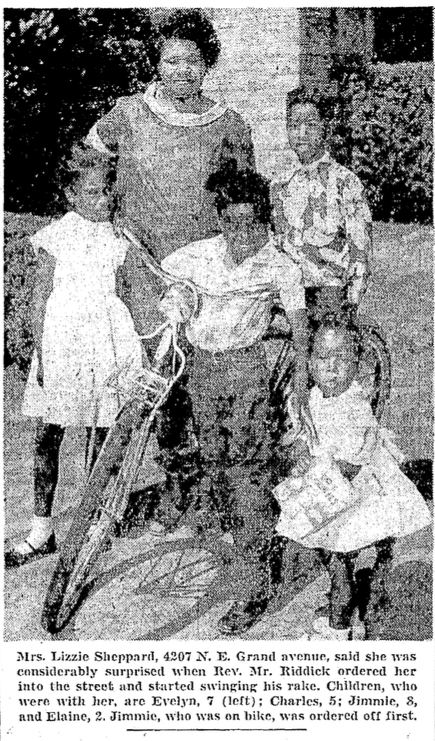
Lizzie Sheppard Took a White Supremacist Pastor to Court and Won

Picture from the Oregonian,
August 20th, 1955
by John Lussier

August 8th, 1955 — Lizzie Sheppard, an expecting mother, and her four kids, were walking the 15 blocks home from the Well-Baby health clinic in North Portland after getting booster shots when they encountered Elbert Riddick, an Episcopal priest. Lizzie’s oldest boy, Jimmie was riding his bike ahead of the family, when Riddick, raking leaves on the sidewalk, told the boy and his family that they couldn’t go past him.

“I don’t want black people walking on my sidewalk.”
“What do you mean?” said Lizzie.
“I mean you black niggers,” replied Riddick.
“That’s not very Christian-like to say something like that… I don’t even know you and you don’t know me,” she replied.
“Get those kids and the bike off my sidewalk and into the street,” said Riddick.

Sheppard tried to push the bike around him and go on but Riddick began to hit her and her 5-year old son Charlie with the rake he was holding. The blows knocked her glasses to the ground, and left welts on her and her son even weeks later.

“I was hollering I guess, but when I saw he was hitting the child I decided I’d better have some help,” said Lizzie, courageously not backing down.

It was at this point a truck driver, having witnessed the scene, stopped and told Riddick to leave Sheppard alone. A neighboring household let Sheppard use their phone to call the police, having to lock Riddick out of the house after he gave chase.

The Rev. Elbert Riddick, 58 at the time, explained to a police office later that he had “…moved out of the colored district to get away from the Negroes.”

Riddick came to Portland in 1937, and had previously been ticketed by police for public disturbance. In 1953 he was the chairman of the Civil Freedom Committee, a local group that had tried unsuccessfully to get Oregon’s public accommodations civil rights law repealed. The law made it illegal for businesses like restaurants, hotels, etc. to discriminate against non-white customers. Riddick’s group believed that their civil freedom was being breached if public services had to cater to African Americans and others. He was part of a long line of white men and women who would seek to use public policy and opinion to enforce racist beliefs.

Riddick was angry at “Negroes,” because they “…sent their women and helpless ones to parade along the street to get people used to them… then they buy in.” Later at trial he would accuse the Urban League of “breaking down barriers so that Negroes could move into neighborhoods occupied by white persons.”

Despite an anonymous threat against her that she “…had better close up and get out of town” Sheppard brought Riddick to court. He was charged with assault and battery, given a bail of $250 (A little over $2000 now), and released.

At the trial Riddick claimed that the issue at hand was over whether “a white man in front of his own home should have to be crowded off his own sidewalk” and that Sheppard should not “parade in neighborhoods where she did not live”. After being found guilty of assault and battery he was fined $50 (about $436 now).

Riddick would later go on to appeal the decision. He said that,

“A man in my position should command some respect. I gave her as much clearance as possible but there wasn’t room for her and the bicycle to get by. When she saw that I would not give way, she apparently ran into the street to attract attention. Then she started dancing and screaming.”
Picture from the Oregonian, August 27th, 1955
He felt that Sheppard and her children should walk on the street since he was working on the sidewalk. “…when in front of my own home I do not feel I must be crowded off the sidewalk. I simply do not give ground!”

Riddick’s stroy was that the pregnant woman had shoved the bicycle against him, and then, seizing the rake from him, hit herself and her son.

“There was no intention on my part—after all, I am a clergyman and it would be difficult for me to strike anyone—to hit her son… His mother lunged at me for the rake. Quite frankly I have never before been attacked physically by a woman, and it was inconceivable a Negro woman would attack a white man. I was astonished.”
At each hearing a number of witnesses reported that Riddick had attacked Sheppard in an “unwarranted and vicious” manner.

After a retrial, and a number of delays by the defense, Riddick was again found guilty by a vote of 11 to 1. Sheppard later went on to sue the Rev. for $5000 in damages for emotional trauma and physical damage.

Riddick died in 1961 having lost this case and leading a dwindling congregation at his home. The Episcopal church eventually had denounced his actions and had removed their name from his church. Even after the trial Riddick continued to hold communion and officiate at local weddings.

Lizzie Sheppard passed away only recently. She went on to become a community worker at the Albina Neighborhood Service Center. There she and other community workers, like Otto Rutherford, worked to house, feed, and serve their community.

In her book Dancing with God: The Trinity from a Womanist Perspective Dr. Karen Baker-Fletcher talks God’s presence in a world of crucifixion and suffering. The Triune God, Parent, Child, and Holy Spirit, dances in the world, overcoming evil through healing. Suffering isn’t something that God redeems, but overcomes. He opens this dance up to his people, asking that they join in on overcoming evil with good. They do so by healing the world, seeking justice in the power of resurrection, and fighting suffering with the courage of God. Lizzie Sheppard is an example of this courageous and healing dance.


The Oregonian reported heavily on this story and made this piece possible. Access was made possible through the Multnomah County Library. All quotes, photos, and accounts of the trial came from the following:


The Oregonian, Aug. 20, 1955, pg. 1, 6; Aug. 21, 1955, pg. 6; Aug. 27, 1955, pg. 1; Sep. 3, 1955, pg. 7; Nov. 11, 1955, pg. 6; March 22, 1956, pg. 28; March 23, 1956, pg. 1; April 30, 1961 pg. 35; April 15, 1966, pg. 6; Feb. 12, 1968, pg. 28

Connect with John Lussier by following him on Twitter: @JohnLuce.
Original blog post: https://medium.com/theology-of-ferguson/lizzie-sheppard-81c82a6c52c9

Monday, February 2, 2015

Student Athlete: Tyler Bickley

by Laura Joy Griffith

Tyler Bickley, a junior shooting guard on Multnomah's men's basketball team, answers my questions!
Tyler Bickley #4
gomulions.com

Major: Business
How long have you played basketball?  6 years
What do you like best about it?
My favorite thing about basketball is the relationships you build with your teammates.  Throughout the ups and downs of the season, you struggle alongside one another, building each other up and competing against other teams.  But the most satisfying part of basketball is when you win as a team and celebrating your victory together.
What is one of the most challenging things about basketball?
The most challenging part of this sport is getting everyone on the same page and working together.  Many times you have one or two people who want to do their own things and it throws off the cohesion that the team has.
What do you like best about Multnomah’s team?
What I like most about Multnomah’s team is that we are all brothers in Christ.  That is a unique element that Multnomah sports in general have over other programs.
What misconceptions do other people have about the Multnomah basketball team?
I think a lot of people see us as “too cool” to hang out with non-athletes.  I think this misconception comes from the bigger, D-1 schools where their athletes get pampered and treated as royalty.  The reality is, at Multnomah, we get treated exactly the same as the non-athletes, no special benefits, same amount of homework, same grading scale.
How can the Multnomah student body support your team?
The best way to support our team is simply coming to our games.  Having a good crowd at our home gym is a huge encouragement and advantage in games.
What is your favorite memory from this season?
              My favorite memory of this season so far was when our JV basketball team beat Concordia’s
              JV team on their home court.  That was only the second time in our school’s history that    
              we’ve beat them and we still have one more game against them this season.

TOMORROW, Tuesday, Feb. 3, Tyler and his teammates are playing against Portland Bible College here on Jim Skagen court at 7 p.m.  Come out and support your Lions!!!


Tuesday, January 27, 2015

MU Street Style

by Laura Joy Griffith

Fashion journalists like to do this thing called "street style," where they go out and take pictures of stylish people on the street, and then post those pictures to blogs or publish them in magazines to serve as inspiration.  I decided to do the same thing, only just on the Multnomah campus.  Below are snapshots of some of your most stylish classmates.  Lookin' good, Multnomah!

Adrie Bickley softens the black of her jeans, booties, and backpack
with lighter colors and gentler shapes on top.

Becka Naydiuk rocks a statement necklace with a simple and classic silhouette. 

Brenna Coy uses layers and an unexpected pop of color to liven up classic pieces.

Chelsea Kopp's casual jeans and plain top still look chic
when paired with a classic coat, black beanie, and TOMS.

It's a little bit backwoods-logger, a little bit Rebel Without a Cause: Clara DeHoog
pulls together rustic and rocker influences to create a classic-cool look.

No one can pull off all-black quite like Darth Vader, Severus Snape, and Josh McKinley.

Layers are key to TK Moffit's casual-chic style, in which his shoes,
scarf, backpack, and headphones all play a vital role.

Do you want to be featured in the next MU Street Style?  Tag @multnomahmuse or #MUStreetStyle in your Instagram pics or send your picture to multnomahmuse@gmail.com.  OR you may just get stopped in the hall, if your look is just that eye-catching.

Monday, January 19, 2015

Calling for Peaceful Reform

by Laura Joy Griffith

Martin Luther King Jr.
            Martin Luther King Jr. advocated peaceful reform.  Lately, the issue of race relations in the United States has been anything but peaceful.  Blacks have died at the hands of police.  Police have died at the hands of the vengeful.  Our country seems to be split down the middle, and I feel like I’m in the center of it all.  I hear people talking about how racist cops are.  A black man can’t put his hood up when he’s walking at night, or he’ll be singled out.  I hear cops talking about how dangerous it is for them right now.  Police have to defend themselves; it’s a dangerous world out there, as the police killings in New York have only served to emphasize.  If you’re like me, you’re probably sick of hearing pointless arguments; you just want peace.
            I think it is important for both sides to realize the bigger problems behind the individual incidents.  We spend so much energy “getting to the facts of the case” (Was the man armed?  Did the officer follow proper procedure?) and ignore the real issue.  Racism is still a problem in America.  Today we salute Martin Luther King Jr. for the work he did, and we are grateful for the progress that has been made in recent decades.  But there is still progress to be made.  Are individual Americans, including police officers, racist?  Undoubtedly, although it may be mostly subconscious.  Is the system racist, including the police system?  Undoubtedly.  Is killing cops the solution?  Of course not!
            What many Americans fail to realize is that police officers typically follow protocol.  If one of their choices is questioned, it may go to court; the court determines whether or not the officer has followed protocol.  An officer who has followed protocol will be acquitted.  Does that mean that whatever the officer did was okay?  Not necessarily.  It just means that he was trained to it, and he did it.  Maybe police procedure needs to change.  That can be changed.  But hatred and violence will not change it.
            I hope I speak in the spirit of Martin Luther King Jr. when I call for peaceful reform today.  I see racism all around me, in individuals and systems—in the dark parts of my own soul that I don’t care to talk about most of the time.  Let’s do something about it!  But, as Dr. King so famously said, “Returning violence for violence multiplies violence, adding deeper darkness to a night already devoid of stars.  Darkness cannot drive out darkness: only light can do that.  Hate cannot drive out hate: only love can do that.”

Tuesday, January 13, 2015

Fashion, Style, or Both?

by Laura Joy Griffith
Coco Chanel

            Coco Chanel said, “Fashion fades; only style remains the same.”  What is the difference between fashion and style?  Aren’t they both about wearing the right clothes—clothes that are in vogue?  I propose that fashion is about societal trends, but style is about personal expression.
            “Fashion is not something that exists in dresses only.  Fashion is in the sky, in the street.  Fashion has to do with ideas, the way we live, what is happening.”  Coco Chanel said that, too.  In the 1920’s, women began wearing short skirts to express their sexual independence.  It happened again in the 1960’s.  Cultural trends created clothing trends.  When society changed, so did fashion.  Every season, designers parade their creations up and down the runway, and magazine editors make this accessible in hundreds of pages of glossy photos.  Fashion changes every season, every month, every day, swayed by innumerable cultural influences.
            Nina Garcia said, “Style is a deeply personal expression of who you are, and every time you dress, you are asserting a part of yourself.”  Style is not about what fashion editors or bloggers are saying; it is about what you choose to put on in the morning.  Miuccia Prada said, “What you wear is how you present yourself to the world.”  Emma Watson said, “There’s nothing interesting about looking perfect—you lose the point.  You want what you’re wearing to say something about you, about who you are.”  What kind of person are you?  Your clothes tell your story.
            I find the distinction between fashion and style incredible freeing for someone like me with a tight budget.  Fashion is an expensive hobby; style is an acquired skill.  Vivienne Westwood said, “Buy less, choose well, and do it yourself!”  In other words, forget fashion—acquire style.

Wednesday, December 3, 2014

Club Corner: M.A.F.I.A

Interview by Laura Joy Griffith with Becky Gerhardus

What’s your club about?
M.A.F.I.A. (short for Missionaries and Friends in America) started about six years ago as a club for MK’s (Missionary Kids, Military Kids, Multicultural Kids, and Moocher Kids), international students, and for people who have an affinity for foreign culture and exotic food.  It is Multnomah’s longest running club and has a rich history with its roots digging into the Dave Jongeward era.
What does a typical meeting look like?
A typical meeting always includes delicious free food and conversation about different cultures with people who share similar interests.
Meeting Times: every other Thursday at 6 pm.
How do interested students get involved?
Many cultures encourage people “dropping in” and sharing food, so feel free to just drop on by at your leisure.  (We don’t bite, I promise.)  Contact Becky Gerhardus either in-person or through email (rgerhardus@my.multnomah.edu) with questions and for more information.